
The Immigrant Complicity Calculus™
A Century+ of Ethical Distancing, Shifting Moral Economies, and the Abandonment of Alignment with Prophetic Imperative

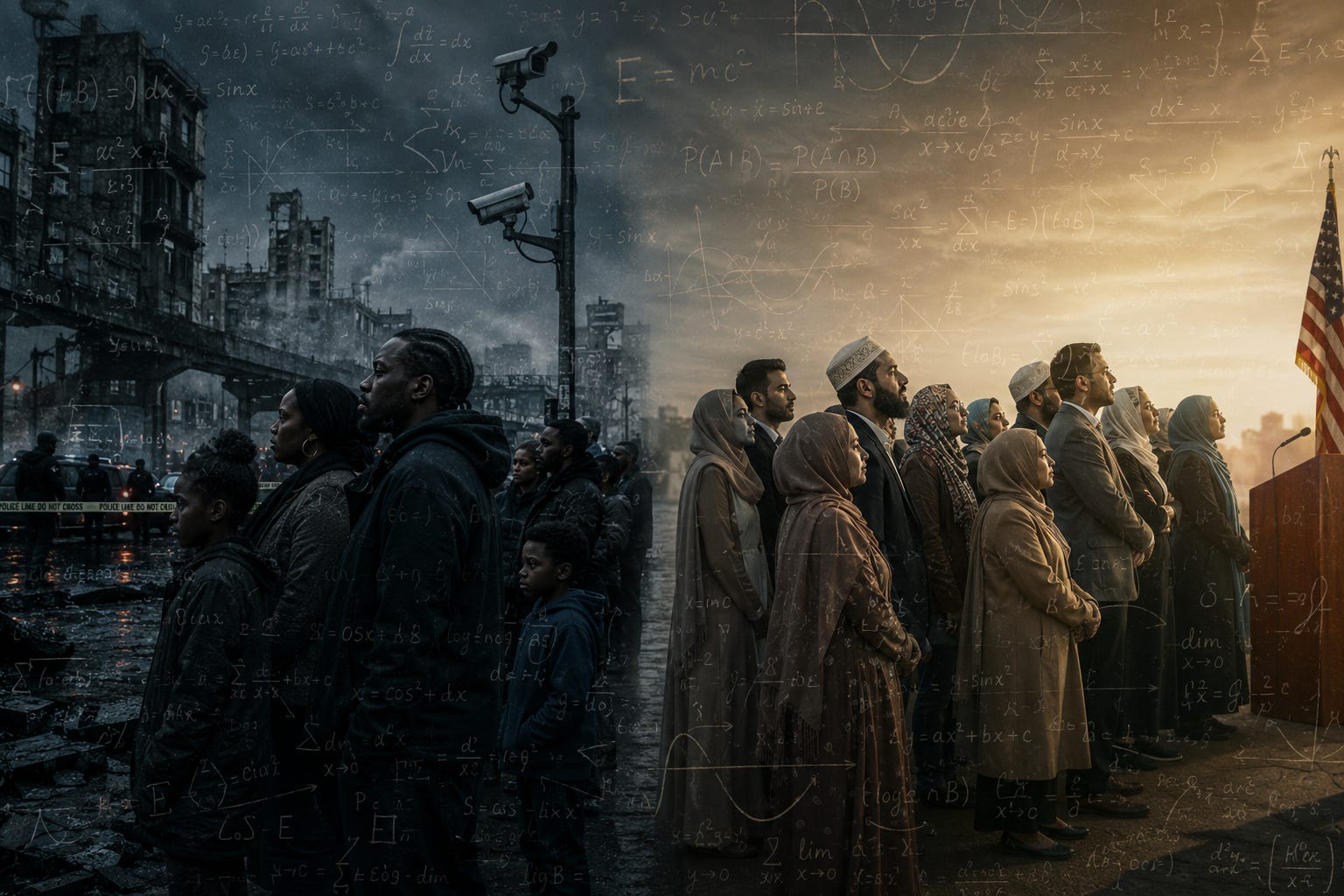
The Invitation
He watched the clip alone, late on a Thursday night, sitting at the desk in the back office after everyone else had gone home. Six minutes. Tucker Carlson, measured and deliberate, naming the Zionist lobby with a directness that American television almost never permits, questioning military aid with the kind of plain spoken skepticism the leader had heard echoed in his own community for years but had never seen reflected back from a mainstream platform. He leaned forward without even realizing he was doing it. He played it again.
It was not that he agreed with everything. He was a careful man, a theologically credentialed man, the kind of leader who spent two decades building relationships across the city's political landscape and who understood that wisdom sometimes required holding public and private positions in productive tension. But watching Tucker, he felt something that surprised him: not agreement exactly, more like the particular relief of hearing a forbidden sentence spoken aloud by someone with enough power to survive saying it.
He forwarded the clip to the group chat just before midnight with a single line: Thoughts?
The thread moved quickly within the community. Fire emojis. Someone said Tucker had obviously been doing his research. Someone else called him the one of the only voices on television willing to say what everyone already knew. He was finally coming around to their side, the right side. The leader read each response and felt the relief deepen into something closer to conviction, and confidences.
At the following week's board meeting, he raised it carefully, after the main agenda items were finished. He started with the political moment: the old coalitions moral fracturing, the Democratic Party's relationship with Muslim communities growing transactional and cold, the sense that institutional Islam in America had made itself legible to only one side of a political binary that was itself dissolving. He talked about the possibility of realignment. He talked about the importance of Muslim institutions being willing to sit across from people who did not share all of their values. He was nearly ten minutes in before he actually said the name.
He had a frame ready for the resistance he expected. This would not be an unqualified endorsement, he planned to say. It would be equal parts interrogation. The community holding its ground, speaking truth to power, refusing to be written off the way the American right had almost always done. He had rehearsed the language on the drive over, the careful reassurances that would signal to the room that no one was getting a free pass, that the institution's integrity was not being compromised but exercised.
But he never needed it.
The room did not push back the way he had anticipated. There were questions, yes, about logistics, about framing, about how the event would be positioned publicly, but beneath them ran a current of something that was not quite enthusiasm and not quite relief, but was closer to both than to resistance. The concerns raised were mostly practical, not moral. No one asked what it would mean to extend to him this platform. No one reached for the language of accountability that he had prepared to meet. The interrogation framing, the truth-to-power scaffolding he had carefully built on the drive over, sat unused. The room did not require it. Didn't want it.
He understood then that the frame had never been for them. It had been for himself.
What the room was offering was simpler and more familiar: the quiet permission of people who had long since made their peace with where the lines were drawn. Tucker Carlson's record against Black communities was not a weight anyone was struggling to set down. It had never really or collectively been picked up. The calculus had already done that work, quietly, invisibly, before anyone had taken their seat. And sitting there, reading the room, the leader felt the last of his prepared resistance dissolve into something he recognized as relief. He was not going to have to argue for this. He was going to be allowed to simply do it.
He settled into that permission and moved the conversation toward logistics.
There were two people sitting near the back of the room who did not speak during the discussion. One was a Black American sister, a founding member who had helped build the center's youth programming fifteen years earlier, who had written the grant that funded the after-school program that was still running, whose name was on the wall in the hallway outside in a way that the current board members walked past every week without pausing. The other was a Sudanese American brother, an engineer, newer to the board, someone who had joined two years ago and had quickly become known for asking the questions in meetings that other people had already decided not to ask. They had not come in together, but they had ended up in adjacent chairs near the back, the way people sometimes do in rooms where the seating carries its own unspoken grammar.
They did not exchange words during the meeting. They did not need to.
It happened in the spaces between the other voices. She watched the room move through its deliberation and felt something clarify inside her that she had been trying to name for years, something about the texture of belonging in this organization, the warmth that had always been present and the distance that had always been present just beneath the warmth, close enough to feel but never close enough to hold up to the light.
She had loved this community. She still did, in the way you love something whose limitations you have learned to absorb so completely that the absorption itself becomes a kind of loyalty. But watching her colleagues now, the Pakistani brothers, the Yemeni elders, the Indian professionals, men and women she had prayed beside and eaten with and argued theology with and mourned with, people she had called her people without hesitation for fifteen years, she watched them settle into their comfort with this decision with an ease that told her the decision had never really been in doubt.
No one looked at her. Not once. Not to gauge her reaction, not to check her face the way people do in rooms when something lands near a nerve, not to invite her in, not even to exclude her with the particular deliberateness that would have at least acknowledged she was there. She was not being avoided. Avoidance would have required prior recognition. What was happening was something quieter and more complete than avoidance.
She began to understand that she was not a variable in the equation.
The calculus had already run before anyone had taken their seat, had already processed the relevant factors and returned its result, and that result did not include her particular inheritance, did not include what this man's public career had meant from where she and people like her had always been standing, did not include the specific weight of watching a room full of Muslim men and women of color calculate their way toward offering a platform to someone who had made a career of erasing her people and calling it analysis.
The brother beside her had gone very still. His eyes betrayed that his own inner calculations had been completed.
She turned her head slightly and found him already looking at her. He was a precise man, careful with his words, not given to expression for its own sake. But what was on his face in that moment was not careful. It was the particular openness that comes when something you have been circling for a long time finally stands still long enough to be seen. He had come to this country at nine years old. He had built his belonging here brick by brick, and part of that construction had taken place inside this organization, inside this room, alongside these people. He had told himself, the way you tell yourself things that help you continue, that the community's occasional failures of solidarity were failures of awareness, failures of exposure, failures that could be corrected with the right conversation at the right moment.
He was not telling himself that now.
What passed between them in that moment was not surprise. Surprise would have meant the possibility had never occurred to them, and it had occurred to both of them, in the private registers where you keep the things you are not ready to say aloud. What it was, was recognition of a different order. Perhaps an unwelcome and unexpected resignation. The calculus, finally, in full light. Not as an abstraction, not as a framework applied to other rooms in other cities, but here, present, operating in real time, among their brothers and sisters, rendered fully visible by the simple and devastating fact that no one in the room had thought to ask either of them anything at all.
Not one question. Not one glance. Not one moment of hesitation that might have suggested their presence was a consideration.
The discussion moved on around them. Someone was talking about logistics. Someone else was refining the framing for the public announcement. The leader was nodding with the quiet authority of a man who had gotten what he came for without having to fight for it. The room was cohering around its decision with the particular ease of people who have confused the absence of dissent with the presence of consensus.
The sister turned back toward the front of the room. So did the brother. They did not speak. There was nothing to say that the silence had not already said more completely, more honestly, and with greater precision than anything the meeting had produced.
They had walked into that room as members of this community. They were leaving as witnesses to it. The difference, they both understood now, was permanent.
By the end of the meeting, a connection had been identified, a call had been made, and a Thursday evening in the following month had been confirmed. The format was agreed upon: a structured conversation on foreign policy, faith, and American political identity. Both sides would retain the right to characterize it in their own terms afterward. Excitement and anticipation was building.
When the leader brought the news back to the board, the room received it with the restrained satisfaction of people who believe they have made a sophisticated decision in unsophisticated times. Someone said it took courage. Someone else said it was exactly the kind of engagement the community needed to be modeling. Others said it was long overdue. The leader accepted these characterizations with the equanimity of a man who had already arrived at peace with his conclusions.
No one mentioned the neighborhoods three miles east of the cultural center, where Tucker Carlson's vision of American order had been applied to Black families for years. That question did not enter the room. The calculus had processed it long before the meeting began and returned a clean result: not relevant to this decision.
The date was set. Everyone felt good about it. That feeling was the last thing the calculus produced before it disappeared back into the walls of the room, invisible again, indistinguishable from wisdom.
The Calculus Convenes
What the room had just completed was not a failure of information. Every person present knew Tucker Carlson's record. What they had completed was a calculation: one with a name, a history, and a logic that runs far deeper than any single Thursday night meeting in any single American city.
Named here as The Immigrant Complicity Calculus™.
The Immigrant Complicity Calculus™ is the systematic process, conscious or unconscious, by which some segments of Arab and Asian Muslim immigrant communities in the United States compute proximity to whiteness as a proxy for safety and legitimacy. It is not a personal moral flaw. It is a system of choices conditioned by fear, aspiration, and inherited colonial logic. And it did not arrive fully formed. It was seeded, then firmed, then hardened across three distinct historical phases that together explain why a room full of educated, well-intentioned Muslim leaders can discuss inviting a white nationalist to their cultural center without once raising the question of what that choice costs Black people.
It was perhaps seeded in the courtroom. From the late nineteenth century onward, Arab, South Asian, and other Muslim immigrants entering the United States encountered a racial republic in which citizenship itself was contingent on whiteness. Arab immigrants fought legal battles to be classified as white. Courts rewarded those who could perform Christian assimilation and penalized those who could not. South Asian Muslims were triangulated as a model minority, valorized for discipline and obedience, penalized for any solidarity with Black or radical movements. The lesson these communities absorbed was not subtle: belonging required distance from Blackness, and that distance was not merely social but juridical, written into the terms of American membership. Those who arrived from formerly colonized regions brought additional freight, Ottoman and British colonial hierarchies that had long equated lighter skin and European culture with civilization, and that mapped with devastating ease onto American racial common sense.
It firmed during the Cold War. The United States cultivated Muslim allies abroad and model Muslims at home, technically trained, socially conservative, politically quiet immigrants who could testify that Islam and American democracy were compatible. The communities that formed around these immigrants absorbed the reward structure clearly: quietism equaled respectability, political restraint equaled legitimacy, and the further one stayed from Black radicalism, the more access one could expect. What had begun as a survival instinct in the courtroom became, in this phase, an institutional posture, taught in mosques, transmitted in families, encoded in the unspoken rules of community life.
It hardened after September 11th. Muslim became a racial category, visible, suspect, and policed. Surveillance infrastructure rewarded those who performed loyalty and punished those who dissented. Countering Violent Extremism programs incentivized cooperation with law enforcement and penalized political independence. The more compliant the community, the more proximity to whiteness it could reclaim. What had been a posture became a reflex, and what had been a reflex became, over time, something that no longer needed to be decided. It simply ran. Institutions reproduced it through grant applications, press releases, board governance, and the particular silences that formed around certain kinds of suffering, Black suffering most reliably and most completely.
Besides there were black scholars and leaders who agreed.
By the time that board meeting convened, the calculus had been running for over a century. No one in the room had invented it. No one had chosen it consciously. They had inherited it, the way one inherits a language: not by deciding to speak it, but by growing up in a house where it was the only tongue available.
The calculus operates through three interlocking sources of fear, apprehension and anxiety.
The first is fear of Black success, the anxiety that Black liberation will expose white identified immigrant moral failure and revoke the borrowed credibility that proximity to whiteness provides. It's important to note that it's a learned fear.
The second is an irrational fear of Black retribution, the projection drawn from colonial pedagogy and white nationalist myth alike, that emancipated Black agency will punish those who stood aside.
The third is fear of white retaliation, the conviction that any visible alignment with Black struggle will invite punishment severe enough to undo everything the community has built.
These fears do not usually announce themselves. They operate as institutional common sense, as strategic wisdom, as the quiet discipline of a room that knows which questions not to ask.
Together they produce a single governing equation: Security = Silence + Distance from Blackness + Performance of Loyalty to Power.
The ICC™ sits within a larger formation named the Madhab of the White Jesus™: the trans-religious moral architecture in which whiteness is reconstituted as theological virtue, in which submission to supremacist order is rebranded as humility, and in which resistance to that order is pathologized as anger, extremism, or spiritual immaturity.
Where the Madhab of the White Jesus™ supplies the creed, the ICC™ supplies the method: the routine calculations through which immigrant institutions, scholars, and families exchange prophetic solidarity for perceived protection.
What makes the calculus durable is that it does not require belief. It requires only participation. Over time, institutions do not simply choose silence; they are built to produce it. Mission statements emphasize unity without defining justice. Programming centers personal piety while avoiding collective harm. When Black suffering threatens to disrupt institutional equilibrium, it is deferred, diluted, or absorbed into broader narratives that erase its specificity.
Palestine becomes the single permissible site of Muslim moral certainty, a vocabulary of injustice that can be safely externalized, that allows denunciation of Western power without risking proximity to Black anger or domestic racial critique. The international vocabulary of resistance conceals a domestic grammar of compliance.
This is what I call Black Narrative Subsumption™: the process by which the specific experiences, testimonies, and resistances of Black communities are absorbed, reframed, or overwritten within immigrant Muslim discourse. Concrete anti-Black violence is redescribed through universal moral vocabulary until the racial target disappears.
The post captioned “We Are All Palestine” runs above a headline describing ICE agents zip-tying Black residents in a Chicago housing complex, and no one in the organization that posted it notices the distance between those two things, because the calculus has already closed it.
The Malcolm X template shows how old this mechanism is. Immigrant Muslim communities constructed a bifurcation of Malcolm's life and thought so clean it became orthodoxy: pre-Hajj Malcolm rejected as too Black, too confrontational, theologically suspect; post-Hajj Malcolm claimed as proof that real Islam transcends race. The post-Hajj Malcolm who was still revolutionary, still critical of Arab racism, still building transnational Black networks was erased. A domesticated figure remained, safe for immigrant moral display, available for invocation in Islamophobia campaigns while the hierarchies he spent his life condemning were quietly reproduced. His legacy, meant as a perpetual critique of anti-Blackness in Muslim life, became its moral cover.
The calculus does not usually collapse under exposure. When confronted with evidence of harm, the ICC™-trained institutional response is not denial but deferral. The question is never whether the harm is real. The question is whether addressing it threatens institutional equilibrium. If it does, the calculus dictates restraint. Over time, restraint becomes habit, and habit becomes norm, and norm becomes the thing someone calls wisdom in a board meeting while everyone nods.
The (Usual) End State
By the time the calculus has converged structurally across institutions, funding streams, leadership pipelines, and educational spaces, it is no longer a pattern of decisions. It is infrastructure. It no longer needs to be argued for or consciously defended. It is simply reproduced through ordinary institutional functioning, through grant applications and press releases and the particular silences that form around certain kinds of suffering.
The end state is not chaos or disruption. It is a stabilized orientation: alignment with power becomes the safest, most predictable path forward. Support for, tolerance of, or silence toward reactionary political figures, authoritarian state practices, or racialized violence is no longer experienced as betrayal. It is experienced as prudence. The calculus has taught its adherents that survival depends on proximity to stability, not solidarity with the vulnerable, and that this preference is not compromise but strategy, not fear but wisdom, not complicity but realism.
For Black Muslims, this end state has a specific meaning. Appeals to shared faith, shared identity, or shared struggle will not move institutions whose survival logic has already been recalibrated to reward accommodation and punish rupture. Solidarity, when offered, will be conditional, symbolic, and easily withdrawn when the cost rises above what the calculus permits.
The Refusal
The alternative is not just persuasion. We've tried that but not exhausted it. It is refusal.
Refusal does not mean disengagement from Islam or abandonment of universal ethics. It means refusing to allow Islam to be filtered through a calculus that prioritizes safety over truth and stability over justice. It means refusing to tether Black Muslim ethical commitments to institutions whose survival depends on distancing themselves from Black liberation. It means rejecting the premise that legitimacy must be granted by structures already aligned with power.
This refusal requires construction: independent theological frameworks that center the oppressed without qualification, institutions that are not financially or reputationally dependent on appeasement, and leadership that understands strategic loss as a possible and sometimes necessary cost of maintaining and sustaining Prophetic integrity. The task is not to purify existing institutions of the calculus's residue. It is to build forms of religious, political, and social life that are not governed by it. To render it null.
For non-Black Muslims, the task is different but no less urgent. It requires a willingness to interrogate how survival strategies have hardened into doctrine, how fear has masqueraded as wisdom, and how the pursuit of safety has too often relied on the containment, erasure, or instrumentalization of Black suffering. That interrogation cannot be performed at a comfortable distance. It has to reach the Thursday night board meeting, the group chat, the moment when everyone in the room knows which question not to ask and chooses, together, not to ask it.
The full paper, The Price of Belonging: The Immigrant Complicity Calculus™ and the Moral Economics of Muslim Integration in America, is available through the Dajalé Institute.
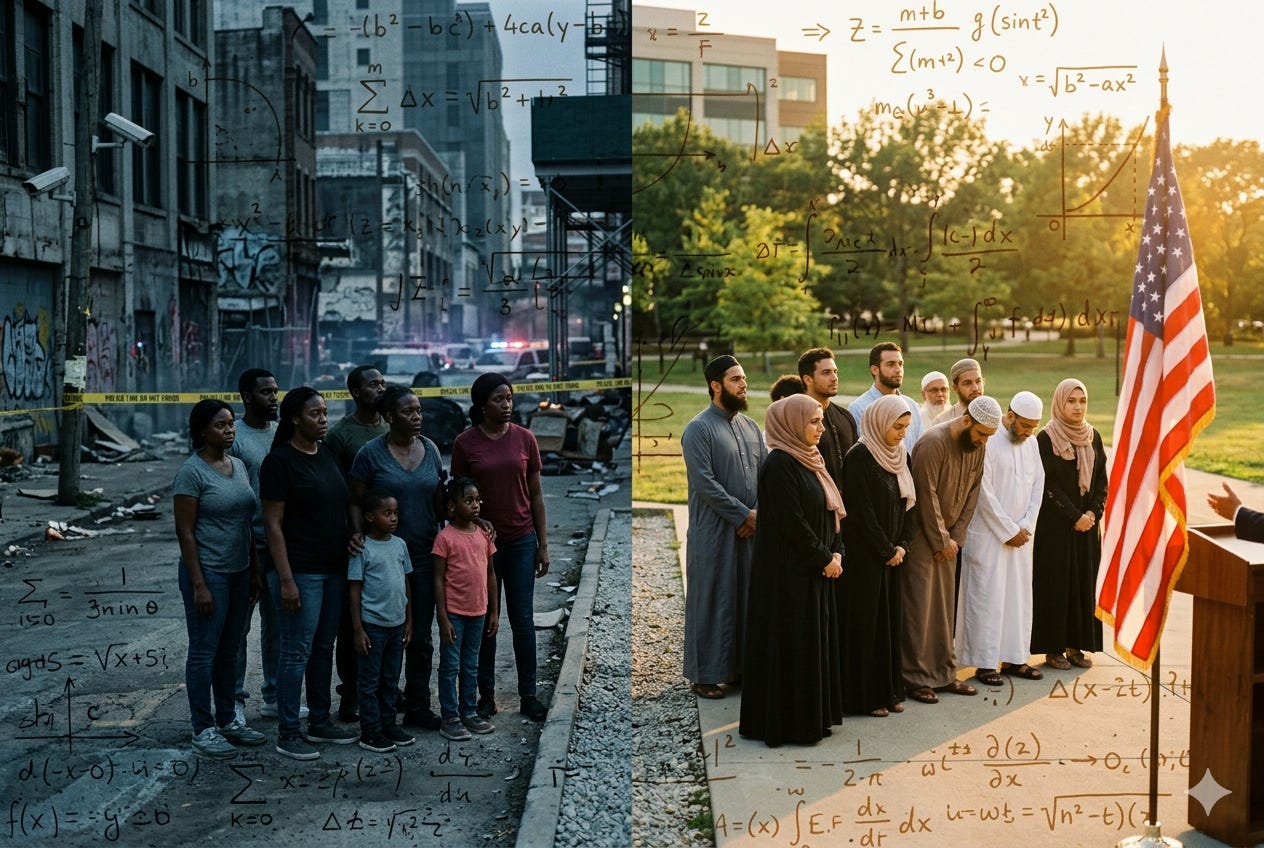
The date was set. Everyone felt good about it. The only question that remains is whether that feeling, the next time it arrives, will be met with clarity, or mistaken, again, for wisdom.
Yusuf Jones is the founder of the Dajalé Institute and the originator of the Technocratic Neo-Apartheid™ and Madhab of the White Jesus™ analytical systems.